Die Polare
Die Polare ist die Abbildung eines Punktes $P_{0}$ (zunächst
einmal
ausserhalb eines gegebenen Kreises) auf eine Gerade g1
, die diesen Kreis so schneidet, dass die
Schnittpunkte die Berührpunkte der beiden von $P_{0}$ an den Kreis gezogene Tangenten
sind!
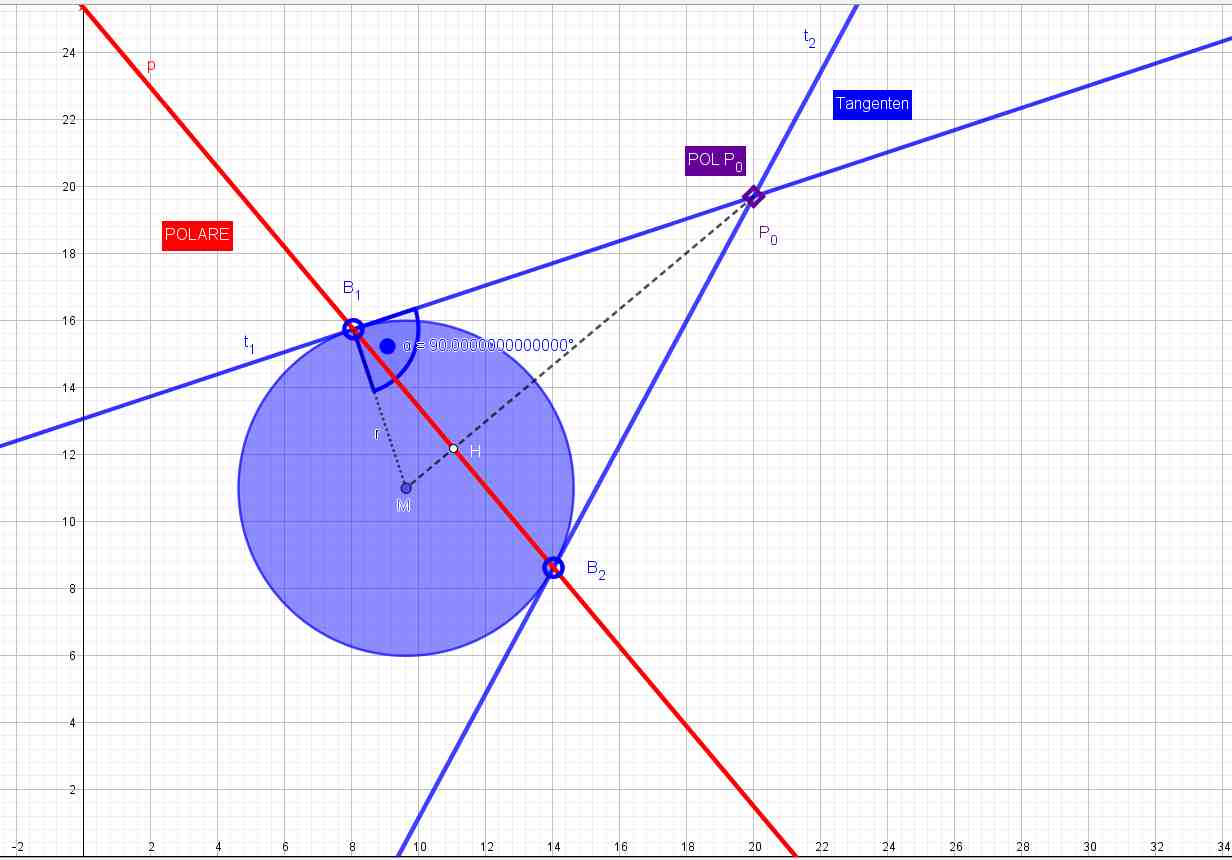
Die Gleichung der POLAREN zum Pol $P_{0}$:
O.B.d.A. legen wir den Kreismittelpunkt in den Ursprung (Verschiebung des Koordinatensystems um den Vektor -xM)! Die Polarengleichung beschreiben wir in der Normalenform $$\boldsymbol{n} \cdot (\boldsymbol{x} – \boldsymbol{x_g}) = 0$$
wobei $\boldsymbol{n}$ Normalenvektor, der Ortsvektor zum Pol $\boldsymbol{P_{0}}$ und $\boldsymbol{x_{g}}$ ein beliebiger Punkt der zu beschreibenden Polaren-Geraden (z.B. die Mitte $H$ der Berührpunktverbindung) ist!
wobei $\boldsymbol{n_{0}}$ der Einheitsnormalenvektor ist, den man durch die Teilung von $\boldsymbol{n}$ durch die Länge von $n = | \boldsymbol{n} | = | \boldsymbol{P_0} |$ erhält, und $d = \boldsymbol{n}_{0}\boldsymbol{x}_g$ der Abstand der Geraden zum Ursprung ist. Nun ist der senkrecht auf der Polaren stehende Normalenvektor $\boldsymbol{n} = \boldsymbol{x_{P_0}}$ der von der Kreismitte zum Pol $\left( x_{P_0}; \: y_{P_0} \right)$ verlaufende Ortsvektor. Da seine Länge $|\boldsymbol{x_{P_0}}| =\sqrt{( x_{P_0}^2 + y_{P_0}^2)}$ gerade die Länge des Ortsvektors $\boldsymbol{x_{P_0}}$ ist, der von der Kreismitte bis zum Pol verläuft, müssen wir die Normalenform durch diese Länge teilen, um den Abstand d der Polaren vom Ursprung zu erhalten. Nun ist aber das Produkt von $d$ mit der Länge $|\boldsymbol{x_{P_0}}|$ nach dem Kathetensatz des Euklid gerade das Quadrat des Kreisradius $r^2$ $$d \cdot \sqrt{( x_{P_0}^2 + y_{P_0}^2)} = r^2$$ und daher hat man statt der HNF: $\boldsymbol{n_0}\cdot\boldsymbol{x} = d$
$$\boldsymbol{x}_{P_0}\cdot\boldsymbol{x} = r^{2}$$Wenn der Pol $\boldsymbol{P_0}$ ein Punkt der Kreislinie ist, liegt der Pol auf der Polaren und ist Berührpunkt $B(x_b; y_b)$.
Berechnen wir nun zu zwei gegebenen Berührpunkten den Pol bzw. zu drei Berührpunkten die Ecken des Dreiecks. Hier nütze ich nun die Gelegenheit, die mit Abstand beste Methode zur Auflösung linearer Gleichungssysteme vorzustellen: Die Determinantenmethode! Es ist nämlich ein handfester Skandal, dass Determinanten in der Schule nicht mehr unterrichtet werden. Es gibt nichts Besseres, wenn man am sichersten, schnellsten und effektivsten lineare Gleichungssysteme auflösen will!!!
Seien nun $B_1(x_1; y_1)$ und $B_2(x_2; y_2)$ zwei Berührpunkte am Einheitskreis (sonst die $1$ durch $r^2$ ersetzen!), dann sind die
Die Lösung für $x$ und $y$ sind die Quotienten zweier Determinanten: Zählerdeterminante $Z_x$ bzw. $Z_y$ durch die Nennerdeterminante $N$, wobei die Nennerdeterminante $N$ einfach diejenige der Koeffizienten der Variablen ist
$$N=\left| \begin{array}{rr} x_1 & y_1 \\ x_2 & y_2 \\ \end{array}\right|=x_1y_2-y_1x_2 $$Wenn diese Nennerdeterminante nicht verschwindet, gibt es immer genau eine eindeutige Lösung! Für die Zählerdeterminante ersetzt man die Variablenspalte durch die Spalte der absoluten Glieder, die auf der anderen Seite des Gleichheitszeichens stehen, was hier eine Einserspalte ist:
$$Z_x=\left| \begin{array}{rr} 1 & y_1 \\ 1 & y_2 \\ \end{array}\right|=y_2-y_1$$$$Z_y=\left| \begin{array}{rr} x_1 & 1 \\ x_2 & 1 \\ \end{array}\right|=x_1-x_2$$
$$x=\frac{(y_2-y_1)}{N}$$
$$y=\frac{(x_1-x_2)}{N}$$
Folgerung:
Sind die Koordinaten der Inkreis-Berührpunkte rational, sind auch die Koordinaten der Ecken rational.
Beispiel:
Die Berührpunkte sind $(0.8;\;0.6)$ und $(0;\;-1)$ $$N=\left| \begin{array}{rr} 0.8 & 0.6 \\ 0 & -1 \\ \end{array}\right|=-0.8-0=-0.8$$ $$x=(y_2-y_1)/N=((-1)-0.6)=-1.6/(-0.8)=2$$ $$y=(x_1-x_2)/(-0.8)=(0.8-0)/(-0.8)=-1$$
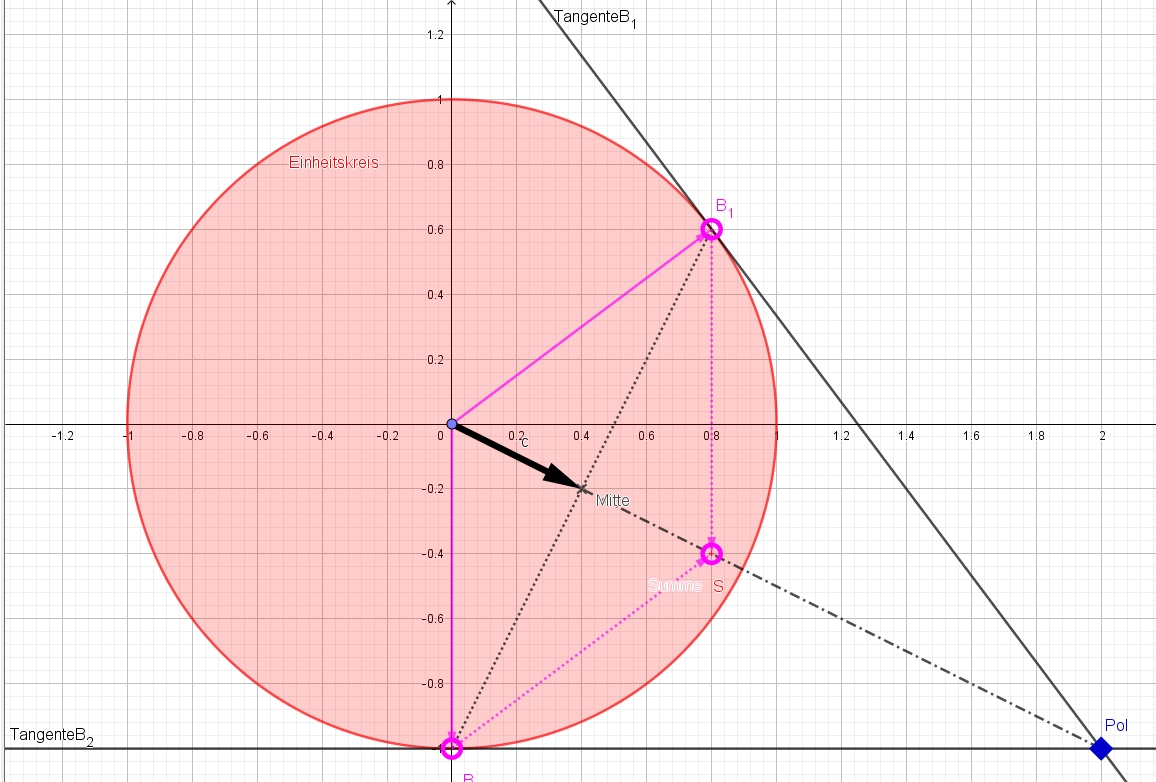
Den Pol (die Ecken) bekommt man durch die Kreisspiegelung der
Verbindungsmitte der beiden Berührpunkte!
Am Einheitskreis ist das Produkt der Längen von Gegenstandspunkt und Bildpunkt gerade $1$
(allgemein
$r^2$), so dass
die Entfernung zum Pol gerade der Kehrwert der halben Vektorsumme der Berührpunkte
(Verbindungsmitte) ist.
Der Summen-Vektor $(0.8;\;-0.4)$ hat die Länge
$\sqrt{.8^2+.4^2}=\sqrt{.8}=\sqrt{4/5}=2\sqrt{5}$. Der
halbe Summenvektor hat also die Länge $\sqrt{5}$.
Der Kehrwert davon ist $\frac{1}{\sqrt{5}}=\sqrt{5}$, und der Pol $(2;\;-1)$
ist genau $\sqrt{1^2+0.2^2}=\sqrt{5}$ entfernt!
Beweise:
- Die Länge des Tangentenabschnitts $t=B_iP_0$ ist gleich dem Produkt der Länge vom Ursprung zu $P_0$ und der halben Entfernung der Berührpunkte $B_1B_2$ (= der doppelten Fläche $2A$ des rechtwinkligen Drachens $OP_0B_1B_2$!)2
-
In komplexer Schreibweise ist der Pol
$P_0=(B_1 \cdot B_2) / [\frac{1}{2}(B_1 + B_2)]$
Anleitung: Zeige, dass die Länge und der Winkel übereinstimmen 3
Fußnoten
- (in der Dimension 2, Ebene in Dim 3 …) ↩︎
- In der Abb. ist $t=2$ und $OP_0=\sqrt{5}$ und die andere Diagonale hat die Entfernung der Berührpunkte $B_1B_2$ $|(0.8;0.6)-(0;-1)|=\sqrt{32}=4\sqrt{5}$ ↩︎
-
Komplex berechnet sich der Pol als verdoppelte Wehrle-Zahl der beiden Berührpunkte; was
dasselbe wie Produkt durch die halbe Summe ist:
Das Produkt ist doch das Minus-i–fache von $(0.8; 0.6)$:
$( 0.8i – 0.6 ) = 0.6 - 0.8i$ (Drehung um $-90$ Grad)
Produkt durch halbe Summe also $$(0.6 -0.8i) /( 0.4-0.2i) =$$ $$(0.6 -0.8i) ( 0.4+0.2i) \; / \; Längenquadrat=0.2$$ $$0.24 + 0.16 - 0.32i +0.12i \; / \;Längenquadrat=1/5$$ $$( 0.4 – 0.2i ) \cdot 5 = 2 - i$$ ↩︎
The Polar
The polar is the mapping of a point $P_{0}$ (initially outside a given circle) onto a line g1, which intersects this circle such that the intersection points are the points of tangency of the two tangents drawn from $P_{0}$ to the circle!
The equation of the POLAR of the pole $P_{0}$:
WLOG we place the center of the circle at the origin (shift of the coordinate system by the vector −xM)! We describe the polar equation in normal form $$\boldsymbol{n} \cdot (\boldsymbol{x} – \boldsymbol{x_g}) = 0$$
where $\boldsymbol{n}$ is the normal vector, $\boldsymbol{P_{0}}$ the position vector of the pole, and $\boldsymbol{x_{g}}$ an arbitrary point of the polar line to be described (e.g. the midpoint $H$ of the segment connecting the points of tangency)!
where $\boldsymbol{n_{0}}$ is the unit normal vector obtained by dividing $\boldsymbol{n}$ by its length $n = | \boldsymbol{n} | = | \boldsymbol{P_0} |$, and $d = \boldsymbol{n}_{0}\boldsymbol{x}_g$ is the distance of the line from the origin. Now, the normal vector $\boldsymbol{n} = \boldsymbol{x_{P_0}}$ standing perpendicular to the polar is the position vector from the circle’s center to the pole $\left( x_{P_0}; \: y_{P_0} \right)$. Since its length $|\boldsymbol{x_{P_0}}| =\sqrt{( x_{P_0}^2 + y_{P_0}^2)}$ is exactly the length of the position vector $\boldsymbol{x_{P_0}}$ from the circle’s center to the pole, we must divide the normal form by this length to obtain the distance $d$ of the polar from the origin. But the product of $d$ with the length $|\boldsymbol{x_{P_0}}|$, by Euclid’s cathetus theorem, is precisely the square of the circle radius $r^2$ $$d \cdot \sqrt{( x_{P_0}^2 + y_{P_0}^2)} = r^2$$ and therefore, instead of the HNF: $\boldsymbol{n_0}\cdot\boldsymbol{x} = d$
$$\boldsymbol{x}_{P_0}\cdot\boldsymbol{x} = r^{2}$$If the pole $\boldsymbol{P_0}$ is a point on the circle, then the pole lies on the polar and is the point of tangency $B(x_b; y_b)$.
Let us now compute, from two given points of tangency, the pole; or from three points of tangency, the vertices of the triangle. I now take the opportunity to present by far the best method for solving systems of linear equations: the determinant method! It is a downright scandal that determinants are no longer taught in school. There is nothing better if you want to solve systems of linear equations in the safest, fastest, and most effective way!!!
Let $B_1(x_1; y_1)$ and $B_2(x_2; y_2)$ be two points of tangency on the unit circle (otherwise replace $1$ by $r^2$), then the
The solutions for $x$ and $y$ are the quotients of two determinants: numerator determinant $Z_x$ or $Z_y$ over the denominator determinant $N$, where the denominator determinant $N$ is simply that of the coefficients of the variables
$$N=\left| \begin{array}{rr} x_1 & y_1 \\ x_2 & y_2 \\ \end{array}\right|=x_1y_2-y_1x_2 $$If this denominator determinant does not vanish, there is always exactly one unique solution! For the numerator determinant you replace the variable column by the column of absolute terms on the other side of the equals sign, which here is a column of ones:
$$Z_x=\left| \begin{array}{rr} 1 & y_1 \\ 1 & y_2 \\ \end{array}\right|=y_2-y_1$$$$Z_y=\left| \begin{array}{rr} x_1 & 1 \\ x_2 & 1 \\ \end{array}\right|=x_1-x_2$$
$$x=\frac{(y_2-y_1)}{N}$$
$$y=\frac{(x_1-x_2)}{N}$$
Conclusion:
If the coordinates of the incircle points of tangency are rational, then the coordinates of the vertices are also rational.
Example:
The points of tangency are $(0.8;\;0.6)$ and $(0;\;-1)$ $$N=\left| \begin{array}{rr} 0.8 & 0.6 \\ 0 & -1 \\ \end{array}\right|=-0.8-0=-0.8$$ $$x=(y_2-y_1)/N=((-1)-0.6)=-1.6/(-0.8)=2$$ $$y=(x_1-x_2)/(-0.8)=(0.8-0)/(-0.8)=-1$$
You obtain the pole (the vertices) by the circle inversion of
the midpoint
of the segment connecting the two points of tangency!
On the unit circle, the product of the distances of object point and image point is exactly $1$
(generally $r^2$), so that
the distance to the pole is precisely the reciprocal of half the vector sum of the points of
tangency (the midpoint).
The sum vector $(0.8;\;-0.4)$ has length $\sqrt{.8^2+.4^2}=\sqrt{.8}=\sqrt{4/5}=2\sqrt{5}$. Half
of the sum vector therefore has length $\sqrt{5}$.
Its reciprocal is $\frac{1}{\sqrt{5}}=\sqrt{5}$, and the pole $(2;\;-1)$
is exactly $\sqrt{1^2+0.2^2}=\sqrt{5}$ away!
Proofs:
- The length of the tangent segment $t=B_iP_0$ equals the product of the length from the origin to $P_0$ and half the distance between the tangency points $B_1B_2$ (= twice the area $2A$ of the right kite $OP_0B_1B_2$!)2
-
In complex notation the pole is
$P_0=(B_1 \cdot B_2) / [\tfrac{1}{2}(B_1 + B_2)]$
Instruction: Show that the length and the angle agree 3
Footnotes
- (in dimension 2, plane in dim 3 …) ↩︎
- In the figure, $t=2$ and $OP_0=\sqrt{5}$ and the other diagonal has the distance between the tangency points $B_1B_2$ $|(0.8;0.6)-(0;-1)|=\sqrt{32}=4\sqrt{5}$ ↩︎
-
In complex terms, the pole is computed as twice the Wehrle number of the two points of
tangency; which is the same as product over half the sum:
The product is the minus‑i multiple of $(0.8; 0.6)$:
$( 0.8i – 0.6 ) = 0.6 - 0.8i$ (rotation by −90 degrees)
Product over half the sum thus $$(0.6 -0.8i) /( 0.4-0.2i) =$$ $$(0.6 -0.8i) ( 0.4+0.2i) \; / \; \text{length squared}=0.2$$ $$0.24 + 0.16 - 0.32i +0.12i \; / \; \text{length squared}=1/5$$ $$( 0.4 – 0.2i ) \cdot 5 = 2 - i$$ ↩︎