Udo Rehle


Neuigkeiten Gaußsche Zahlenebene

Meine Entdeckungen mit Hilfe der komplexen Zahlen in der Gaußschen Zahlenebene

Es ist sehr schwer geworden in der Mathematik noch etwas Neues zu entdecken!

Hier beschreibe ich einige meiner Entdeckungen mit Hilfe der komplexen Zahlen in der Gaußschen Zahlenebene!


Die gerade Linie der Planimetrie ist nichts anderes als eine geometrische Interpretation der unendlichen Zahlen. Daher auch der Begriff der Zahlengerade! Leider ist das nicht die Abbildung der Wirklichkeit des Alls oder eines zweidimensionalen Schnitts des Raums, denn in der physikalischen Realität existiert nichts Unendliches!

Wie sagte der Albert so schön: Es gibt nur zwei Unendlichkeiten!


  1. Die Dummheit der Menschen
  2. Das Weltall

Aber ob das Weltall unendlich ist, da sei er sich nicht so sicher (ist es ganz sicher nicht – wie er weiß!)


Allerdings lehrt man in allen Schulen bis heute ausschließlich nur die euklidische Geometrie: Wenn man zwei Geraden im Ursprung senkrecht aufeinander stellt, spricht man von einem kartesischen Koordinatensystem oder einer Ebene, die jedem Punkt eine Ordinate und eine Abszisse (Ko-Ordinate) zuordnet und umgekehrt. Diese kann man einfacher mit einer einzigen Zahl, nämlich komplex beschreiben.


Aber obwohl komplexe Zahlen die ultimativ letzte „voll-symmetrische“ Köpererweiterung des Zahlenbereich und zB. für die Schrödinger-Gleichung unentbehrlich sind, werden sie in unseren Schulen nicht mehr oder kaum noch unterrichtet! Die komplexen Zahlen sind zweidimensional und eignen sich daher hervorragend zur Beschreibung der zweidimensionalen Ebene!


Die reelle Zahlengerade liefert die x-Achse. Eine Multiplikation mit der imaginären Einheit $i = \sqrt{-1}$ ist immer eine Drehung um 90º um den Ursprung im mathematisch positiven Sinn (= entgegen dem Uhrzeigersinn) und wir erhalten die imaginäre Achse als y-Achse.

Somit besteht eine umkehrbar eindeutige Beziehung zwischen den Punkten und den komplexen Zahlen. Die Darstellung von Geraden mittels einer komplexen Geradengleichung geschieht nun natürlich nicht mehr mit den beiden Variablen x und y, sondern durch eine Variable $z = x+iy$ und ihr konjugiert komplexes (hier immer mit einem Asterix gekennzeichnet)

$$z^*=x-iy$$

Die Addition von $z$ und $z^*$ liefert den doppelten Realteil, nämlich $2x$. $$x = \frac{1}{2}(z+z^*)$$ Und die Differenz von $z$ und $z^*$ ergibt den doppelten Imaginärteil $2yi$. $$y = \frac{z-z^*}{2i} = -\frac{1}{2}(z-z^*)i$$ da ja $i^2=-1$. ist


Interessanterweise lassen sich nun damit die exakten Koordinaten von Schnittpunkten oder Kreismittelpunkten berechnen!

Kennen wir eine Gleichung, in der nur Kreiskrümmungen vorkommen, dann erhalten wir eine Gleichung mit deren Kreiszentren ganz einfach, indem wir hinter jeder Krümmung mit dem entsprechenden komplexen Kreiszentrum $z$ multiplizieren. Das ist erstaunlich, und man kann die Kreiszentren berechnen!

Die Krümmung $\kappa$ eines Kreises ist der Kehrwert seines Radius

$$\kappa=\frac{1}{r}$$

Deshalb haben Geraden die Krümmung Null, denn es sind Kreise mit unendlich großem Radius! Und Punkte haben einen verschwindenden Radius, und haben daher eine unendliche Krümmung, denn sie sind unendlich krumme Kreise!!

Jede Gleichung aus nur Krümmungen kann man komplex erweitern, indem man jede Krümmung mit jeweils dem entsprechenden Kreismittelpunkt multipliziert, der komplex beschrieben wird!

Für die Summe der drei Ankreiskrümmungen $\kappa_a+\kappa_b+\kappa_c$ gilt, dass sie gleich der Krümmung $\frac{1}{r}$ des Inkreises ist!

$$\kappa_a+\kappa_b+\kappa_c=\kappa$$

wobei $\kappa = 1/r$ und $r$ der Inkreisradius ist. (Ankreise heißen engl. „excenter“, denn sie liegen immer außerhalb des Dreiecks)

Die Ankreiskrümmungen sind nämlich $x/A$, $y/A$ und $z/A$, wobei $x$, $y$ und $z$ die Tangentialabschnitte sind, für die die Summe je zweier eine Dreiecksseitenlänge ist und daher

$$\frac{x}{A}+\frac{y}{A}+\frac{z}{A}=\frac{u}{2A}=\frac{1}{r}$$

Sind die alle Seiten von außen berührenden drei Ankreisradien $r_a$, $r_b$ und $r_c$, dann gilt also

$$\kappa_a+\kappa_b+\kappa_c = \kappa_{Inkreis}$$

oder anders mit den Radien formuliert

$$\frac{1}{r_a}+\frac{1}{r_b}+\frac{1}{r_c} = \frac{1}{r}$$

Interessant ist nun, dass auch die Komplexifizierung mit den Kreis-Zentren als Faktoren

$$Z_a K_a + Z_b K_b + Z_c K_c = Z_{M_{Inkreis}} K_{Inkreis}$$

oder

$$\frac{Z_a}{r_a}+\frac{Z_a}{r_a}+\frac{Z_a}{r_a} = \frac{Z_{M_{Inkreis}}}{r}$$

richtig ist!

$Z_i$ (für $i = a,b,c$) sind die Ankreiszentren (komplex geschrieben)

Betrachten wir ein einfaches Beispiel: Das kleinste natürliche Dreieck mit ganzzahligen Seitenlängen und Inhalt. Seitenlängen: $3$, $4$, $5$. Flächeninhalt: $6$. $A=4$, $B = 3i$ und $C = 0+0i = 0$ $$\frac{Z_a}{r_a}+\frac{Z_b}{r_b}+\frac{Z_c}{r_c} = \frac{Z_{M_{Inkreis}}}{r}$$

$Z_A = -2 + 2i, \quad r_a = 2$.

$Z_B = 3 - 3i, \quad r_b = 3$.

$Z_C = 6 + 6i, \quad r_c = 6$.

$$\frac{-2+2i}{2}+\frac{3-3i}{3}+\frac{6+6i}{6} = \frac{1+i}{1}$$
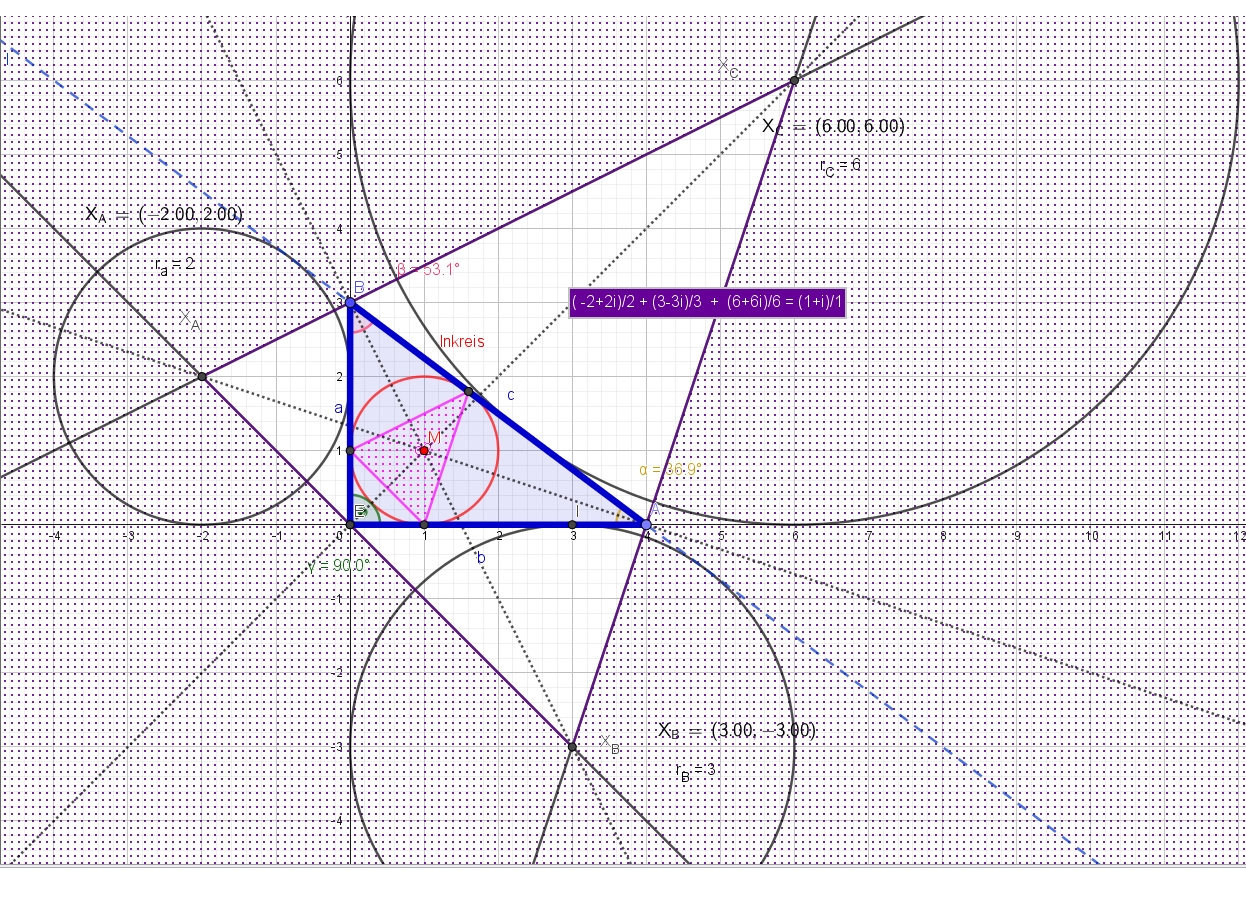
Gaussche-Ebene-Beispiel

Übrigens gibt es einen bekannten Kreis, der all diese vier berührt; der Kreis durch die drei Seitenmitten (zu Ehren nach Karl Feuerbach benannt)! Aber die drei Ankreise berühren sich nicht, d.h. wir können den komplexen DESCARTES nicht anwenden.

Wenn drei Kreise sich gegenseitig berühren, dann gibt es einen vierten (inneren oder äußeren) Kreis, der alle diese drei Kreise berührt.

Als einfaches Beispiel seien die drei Kreise

  1. Der Einheitskreis um den Ursprung mit Mitte $z_1=0$ und Radius $r_1=1$
  2. Der Kreis um den Punkt 3 auf der x-Achse $z_2=3$ und dem Radius $r_2=2$
  3. Der Kreis um den Punkt 4 auf der y-Achse $z_3=4i$ und dem Radius $r_3=3$

Für die Krümmung des vierten Kreises $\boldsymbol{\kappa_4 = \frac{1}{r_4}}$ gibt es zur Berechnung die folgende Formel: $$\boldsymbol{\kappa_4=\kappa_1+\kappa_2+\kappa_3\pm 2 \sqrt{\kappa_1\kappa_2+\kappa_1\kappa_3+\kappa_2\kappa_3}}$$ (vergleiche Arno Fehringer >>Die Unbekannte Formel von Descartes<<)

In unserem Beispiel hat der vierte Kreis die Krümmung $$\boldsymbol{\kappa_4}=\frac{1}{1}+\frac{1}{2}+\frac{1}{3}\pm 2\sqrt{1\cdot\frac{1}{2}+1\cdot\frac{1}{3}+\frac{1}{2}\cdot\frac{1}{3}}$$ $$=1+\frac{5}{6}\pm 2\sqrt{\frac{1}{2}+\frac{1}{3}+\frac{1}{6}}=\frac{11}{6}\pm 2\sqrt{1}$$ $$=\frac{11}{6}+2=\boldsymbol{\frac{23}{6}}$$ Der von innen alle drei Kreise mit den Radien $1$, $2$ und $3$ berührende Kreis hat also den (kleinen) Radius $r_4=\frac{6}{23}$ ($\to$ Abbildung 1)

(der zweite Wert liefert den äußeren Berührkreis mit dem Radius $r_4 = -6$ und der Mitte $3+4i$)
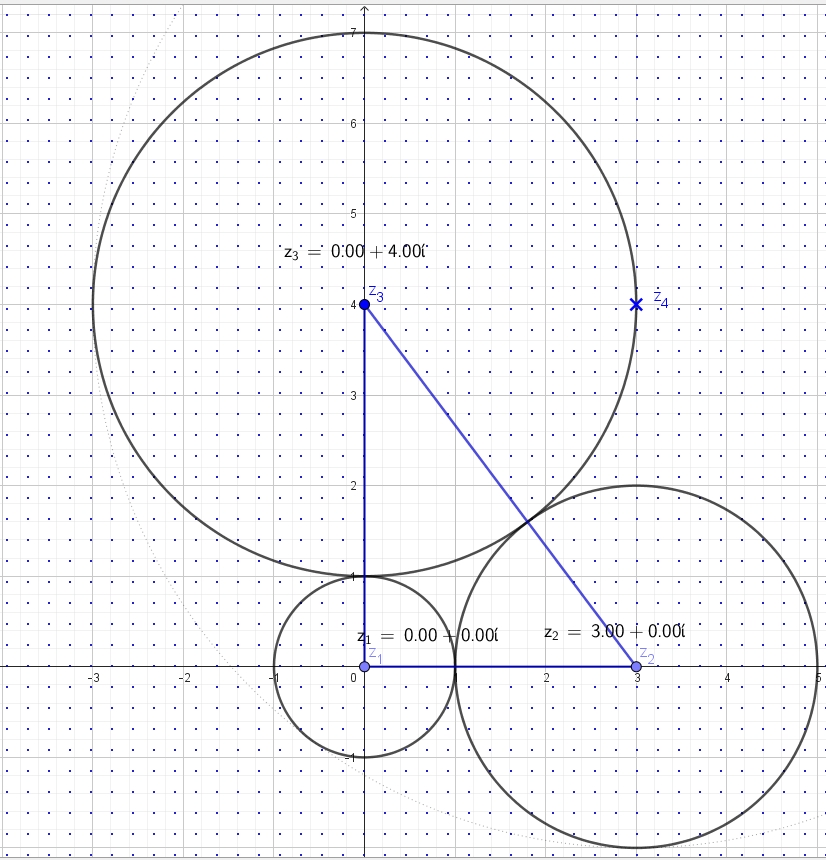

Kreise-Gaussche-Zahlenebene
Abbildung 1

Aber wo ist das Zentrum von diesem inneren Berühr-Kreis?
Dafür komplexifizieren wir diese Formel, indem wir jede Krümmung mit seinem zugehörigen (komplex geschriebenen) Kreiszentrum multiplizieren, also jedes $\boldsymbol{\kappa_1}$ mit $z_1$, $\boldsymbol{\kappa_2}$ mit $z_2$ und $\boldsymbol{\kappa_3}$ mit $z_3$ $$\kappa_4 \boldsymbol{z_4}=\kappa_1\ \boldsymbol{z_1} + \kappa_2\ \boldsymbol{z_2} +\kappa_3\ \boldsymbol{z_3} \pm 2 \sqrt{\kappa_1\kappa_2 \boldsymbol{z_1}\boldsymbol{z_2}+\kappa_1\kappa_3\boldsymbol{z_1}\boldsymbol{z_3}+\kappa_2\kappa_3\boldsymbol{z_2}\boldsymbol{z_3}}$$ In unserem Fall wird wegen $\boldsymbol{z_1}=0$ die WURZEL einfacher zu $\sqrt{\kappa_2 \boldsymbol{z_2} \kappa_3 \boldsymbol{z_3}}$ $$\kappa_4 \boldsymbol{z_4}=1\cdot 0+\kappa_2\boldsymbol{z_2}+\kappa_3\boldsymbol{z_3}\pm 2 \sqrt{\kappa_2\kappa_3\boldsymbol{z_2}\boldsymbol{z_3}}$$ also $$\kappa_4 \boldsymbol{z_4}=\frac{1}{2}\cdot \boldsymbol{3}+\frac{1}{3}\cdot \boldsymbol{4i} \pm 2 \sqrt{\frac{1}{2}\cdot \boldsymbol{3} \cdot \frac{1}{3} \cdot \boldsymbol{4i}}$$ $$=1,5 + \frac{4}{3}\boldsymbol{i} + 2 \sqrt{2\boldsymbol{i}}$$ Da nun die Wurzel aus $\boldsymbol{i}$ gerade das $\frac{1}{\sqrt{2}}=\frac{1}{2}\sqrt{2}$ fache von $(1+\boldsymbol{i})$ ist, wird $\kappa_4 \boldsymbol{z_4} =1,5 + \frac{4}{3} \boldsymbol{i} + 2(1+\boldsymbol{i})= 3,5 + 3,33333…\boldsymbol{i}$ mit dem schon berechneten $\boldsymbol{\kappa_4} =\frac{23}{6}$ können wir den Mittelpunkt $\boldsymbol{z_4}$ berechnen, indem wir mit $6$ multiplizieren und durch $23$ dividieren: $$\boldsymbol{z_4} = (3,5 + 3,33333…\boldsymbol{i})\cdot \frac{6}{23}$$ $$= \frac{21}{23} + \frac{20}{23} \boldsymbol{i}$$ Der gesuchte Mittelpunkt ist $\boldsymbol{(0.9130434783…; 0.8695652174…)}$
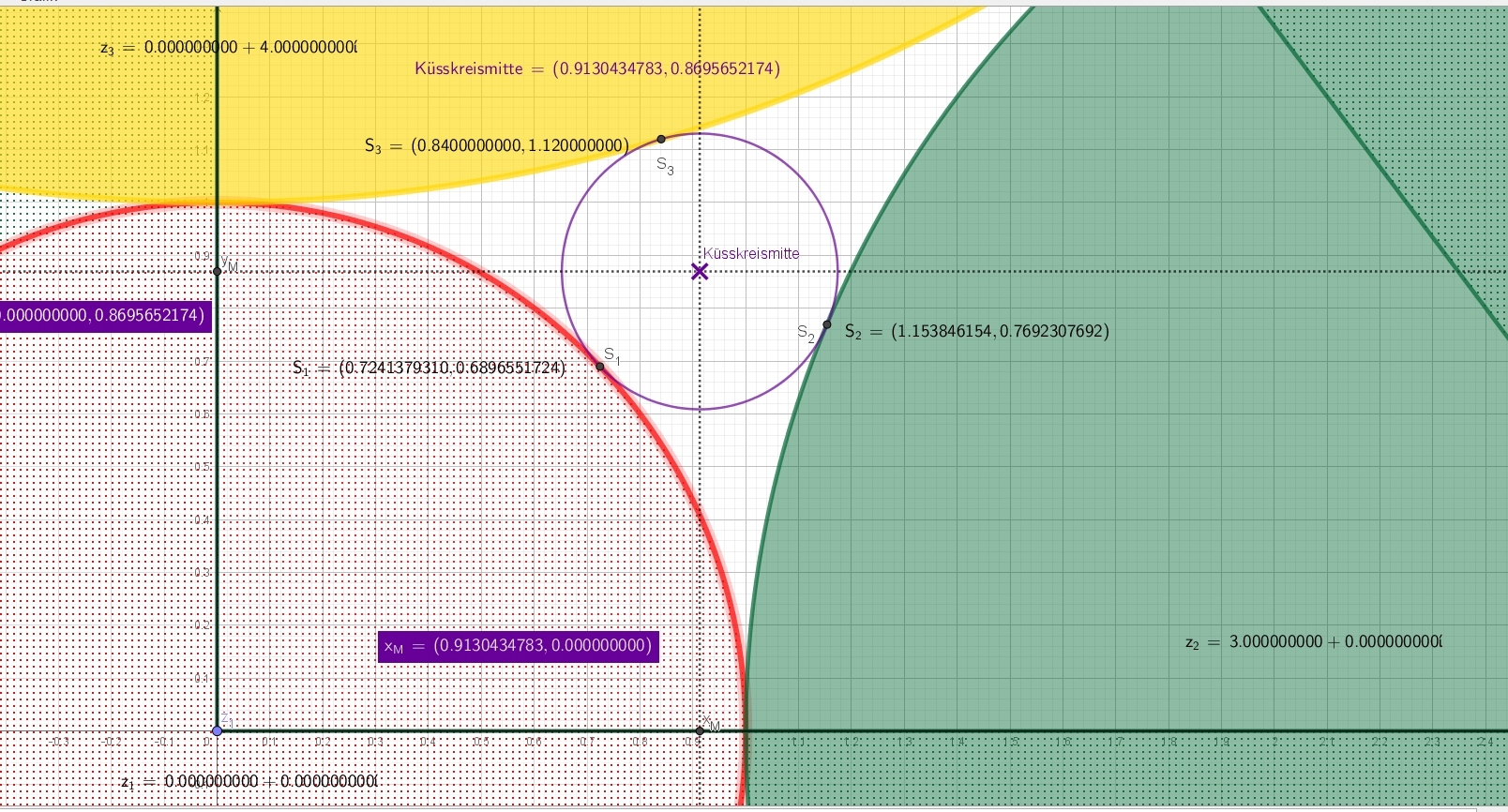
Kreise-Gaussche-Zahlenebene-2
Abbildung 2


Die komplexe Dreiecksgeometrie eignet sich hervorragend zur Berechnung der besonderen Punkte oder von Punkt-Entfernungen im Dreieck. Als möglichst einfaches Beispiel betrachten wir nur rechtwinklige Dreiecke mit $C=(0; 0)$, $A=(a; 0)$ und $B=(0; b)$ ( z.B. $a=3$ und $b=4$ )

Das Inkreiszentrum ist nun $$\boldsymbol{M}_i = r + \boldsymbol{i}r$$ d.h. hat die Koordinaten $(r; r)$ und die Inkreismitte bildet mit der rechten Ecke $C$ ein Quadrat! Den Inkreisradius erhalten wir mit $r = \frac{1}{2}(a+b-c)$, was in der obigen Abbildung $r = 1$ ist.

Allgemein für jedes beliebige Dreieck ist das Inkreiszentrum (für die Seitenlängen $a$, $b$ und $c$ mit $u=∑a_i = a+b+c$) $$\boldsymbol{M}_i = \frac{(a\boldsymbol{A}+b\boldsymbol{B}+c\boldsymbol{C})}{u}$$ d.h. es sind die mit der Seitensumme u gemittelten SeitenEckenProdukte: die x-Koordinate ist $$\boldsymbol{M}_x = (a\boldsymbol{A}_x+b\boldsymbol{B}_x+c\boldsymbol{C}_x)/u$$ und die y-Koordinate ist $$\boldsymbol{M}_y = (a\boldsymbol{A}_y+b\boldsymbol{B}_y+c\boldsymbol{C}_y)/u$$ Jeder besondere Punkt des Dreiecks ist eine Funktion der drei Eckpunkte $A$, $B$ und $C$. Viele besonderen Punkte (wie die Umkreismitte) sind allerdings etwas schwieriger! Einige einfache Beispiele seien nur kurz erwähnt: Der Seitenmittenkreis ist der Umkreis des Mittendeiecks (= Dreieck der Seitenmitten) Das Zentrum des Seitenmittenkreises (Feuerbach) ist allgemein die Mitte von $HM_u$ $$\boldsymbol{M}_u= \frac{1}{2}(\boldsymbol{A}+\boldsymbol{B})$$ (der Höhenschnitt H ist im Ursprung an der echten Ecke C).

Das Umkreiszentrum des Mittendreiecks $\boldsymbol{M}_F$ ist nun $$\boldsymbol{M}_F = \frac{1}{4}(\boldsymbol{A}+\boldsymbol{B})$$ ($C$ ist Ursprung) während der Schwerpunkt $\boldsymbol{S}=\frac{1}{3}(\boldsymbol{A}+\boldsymbol{B})$ ist.
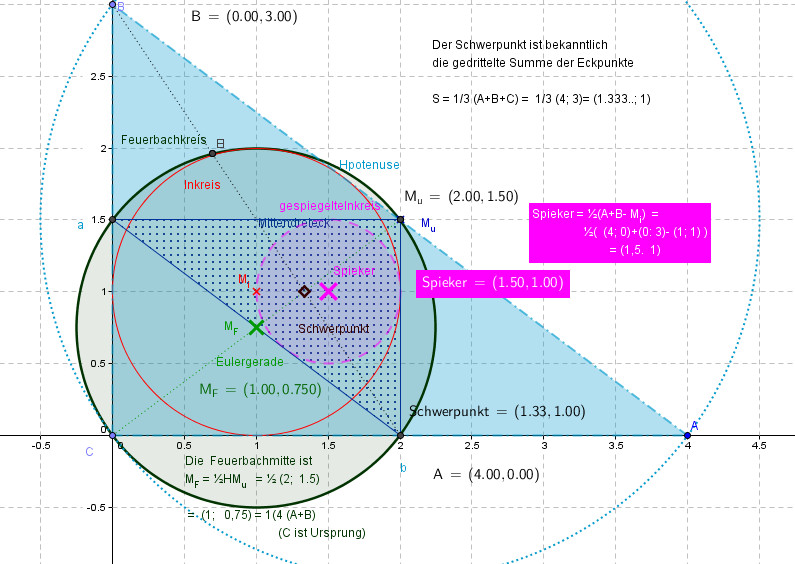


Feuerbachkreis-Gaussche-Zahlenebene
Abbildung 3


Der Spiekerkreis ist der Inkreis des Mittendreiecks Es ist der zentrisch am Schwerpunkt $S=\frac{(\boldsymbol{A}+\boldsymbol{B})}{3}$ gestreckte Inkreis mit dem Steckungsfaktor $k = -\frac{1}{2}$ $$Spieker = \frac{1}{2}(\boldsymbol{A}+\boldsymbol{B} – \boldsymbol{M}_i)$$
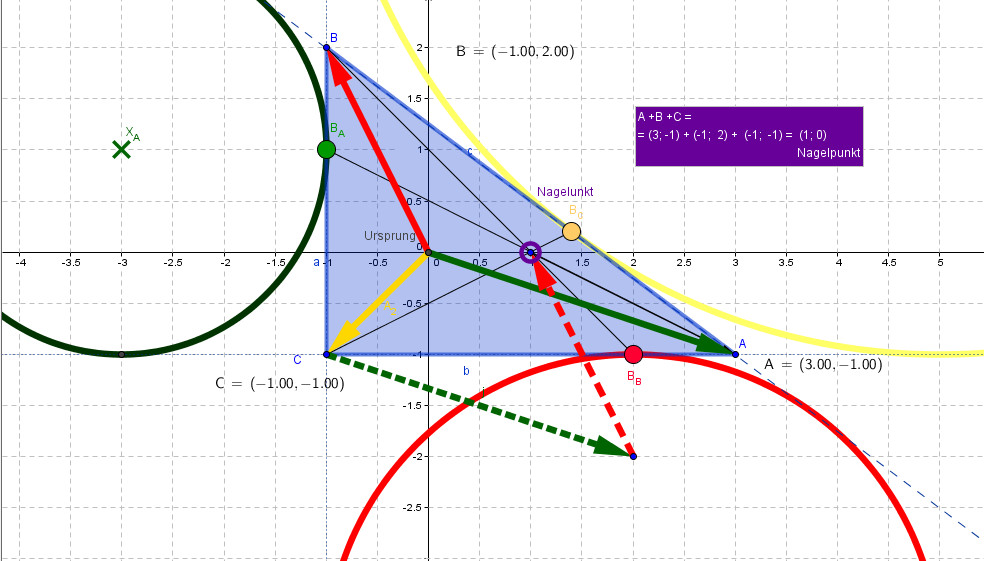

Nagelpunkt-Gaussche-Zahlenebene
Abbildung 4


$$Nagel = A+B+C$$

Erstaunlich einfach ergibt sich der Nagelpunkt als Eckensumme $A+B+C$, wenn die Inkreismitte im Ursprung liegt! Er ist der Schnittpunkt der drei Verbindungen der Ankreis-Berührpunkte der jeweiligen drei Seiten mit den diesen gegenüberliegenden Ecken.
Die allgemeine Formel ist $$A+B+C-2\boldsymbol{M}_i$$

Udo Rehle


News: Gaussian Number Plane

My discoveries using complex numbers in the Gaussian number plane

It has become very hard to discover anything truly new in mathematics!

Here I describe some of my discoveries made with the help of complex numbers in the Gaussian number plane.


The straight line of planimetry is nothing other than a geometric interpretation of the infinite set of numbers. Hence the term number line! Unfortunately, this is not a mapping of reality in the universe or of a two-dimensional slice of space, because nothing infinite exists in physical reality!

As Albert put it so nicely: there are only two infinities!


  1. The stupidity of humans
  2. The universe

But whether the universe is infinite—he was not so sure about that (it most certainly is not, as he knew!).


However, in schools to this day one teaches almost exclusively Euclidean geometry: If two lines are placed perpendicular to each other at the origin, we speak of a Cartesian coordinate system or a plane that assigns each point an ordinate and an abscissa (co-ordinate) and vice versa. This can be described more simply with a single number—namely, a complex number.


Yet although complex numbers are the ultimate, fully symmetric field extension of the number system and, for example, indispensable for the Schrödinger equation, they are hardly taught in our schools anymore! Complex numbers are two-dimensional and are therefore excellent for describing the two-dimensional plane.


The real number line gives the x-axis. Multiplication by the imaginary unit $i = \sqrt{-1}$ is always a rotation by $90^\circ$ about the origin in the mathematically positive sense (counter-clockwise), yielding the imaginary axis as the y-axis.

Thus, there is a bijective correspondence between points and complex numbers. The representation of lines by a complex line equation no longer uses the two variables $x$ and $y$, but a single variable $z = x + i y$ and its complex conjugate (here always marked with an asterisk)

$$z^* = x - i y$$

Adding $z$ and $z^*$ yields twice the real part, namely $2x$: $$x = \frac{1}{2}(z+z^*)$$ And the difference of $z$ and $z^*$ gives twice the imaginary part, $2 y i$: $$y = \frac{z - z^*}{2 i} = -\frac{1}{2}(z - z^*) i$$ since $i^2 = -1$.


Interestingly, this allows us to compute exact coordinates of intersection points or circle centers!

If we know an equation involving only circle curvatures, then we obtain an equation for the corresponding circle centers simply by multiplying each curvature by its complex circle center $z$. That is remarkable—and we can compute circle centers!

The curvature $\kappa$ of a circle is the reciprocal of its radius

$$\kappa = \frac{1}{r}$$

Therefore, straight lines have curvature zero, because they are circles with infinitely large radius! And points have vanishing radius and therefore infinite curvature—they are infinitely curved circles!

Any equation consisting only of curvatures can be complexified by multiplying each curvature by the corresponding (complex) circle center!

For the sum of the three excircle curvatures $\kappa_a+\kappa_b+\kappa_c$ we have that it equals the curvature $\frac{1}{r}$ of the incircle!

$$\kappa_a+\kappa_b+\kappa_c=\kappa$$

where $\kappa = 1/r$ and $r$ is the inradius. (Excircles are called “excenters” in English, because they always lie outside the triangle.)

The excircle curvatures are $x/A$, $y/A$, and $z/A$, where $x$, $y$, and $z$ are the tangent-segment lengths whose pairwise sums give a side length of the triangle, hence

$$\frac{x}{A}+\frac{y}{A}+\frac{z}{A}=\frac{u}{2A}=\frac{1}{r}$$

If $r_a$, $r_b$, and $r_c$ are the three excircle radii tangent to the triangle from the outside, then

$$\kappa_a+\kappa_b+\kappa_c = \kappa_{\text{incircle}}$$

or, in terms of the radii,

$$\frac{1}{r_a}+\frac{1}{r_b}+\frac{1}{r_c} = \frac{1}{r}$$

It is now interesting that the complexification with circle centers as factors also gives

$$Z_a K_a + Z_b K_b + Z_c K_c = Z_{M_{\text{incircle}}} K_{\text{incircle}}$$

or

$$\frac{Z_a}{r_a}+\frac{Z_a}{r_a}+\frac{Z_a}{r_a} = \frac{Z_{M_{\text{incircle}}}}{r}$$

as a valid identity!

$Z_i$ (for $i = a,b,c$) are the excircle centers (written as complex numbers).

Consider a simple example: The smallest integer right triangle with integer side lengths and area. Side lengths: $3$, $4$, $5$. Area: $6$. $A=4$, $B = 3i$, and $C = 0+0i = 0$. $$\frac{Z_a}{r_a}+\frac{Z_b}{r_b}+\frac{Z_c}{r_c} = \frac{Z_{M_{\text{incircle}}}}{r}$$

$Z_A = -2 + 2i,\quad r_a = 2$.

$Z_B = 3 - 3i,\quad r_b = 3$.

$Z_C = 6 + 6i,\quad r_c = 6$.

$$\frac{-2+2i}{2}+\frac{3-3i}{3}+\frac{6+6i}{6} = \frac{1+i}{1}$$

Gaussian-plane example

Incidentally, there is a well-known circle that touches all four of these: the circle through the three side midpoints (named in honor of Karl Feuerbach)! But the three excircles do not touch one another, i.e. we cannot apply the complex DESCARTES.

If three circles are mutually tangent, then there exists a fourth (inner or outer) circle that is tangent to all three.

As a simple example, consider the three circles

  1. The unit circle centered at the origin with center $z_1=0$ and radius $r_1=1$
  2. The circle centered at the point $3$ on the x-axis, $z_2=3$, with radius $r_2=2$
  3. The circle centered at the point $4$ on the y-axis, $z_3=4i$, with radius $r_3=3$

The curvature of the fourth circle $\boldsymbol{\kappa_4 = \frac{1}{r_4}}$ can be computed with: $$\boldsymbol{\kappa_4=\kappa_1+\kappa_2+\kappa_3\pm 2 \sqrt{\kappa_1\kappa_2+\kappa_1\kappa_3+\kappa_2\kappa_3}}$$ (cf. Arno Fehringer »Die Unbekannte Formel von Descartes«)

In our example the fourth circle has curvature $$\boldsymbol{\kappa_4}=\frac{1}{1}+\frac{1}{2}+\frac{1}{3}\pm 2\sqrt{1\cdot\frac{1}{2}+1\cdot\frac{1}{3}+\frac{1}{2}\cdot\frac{1}{3}}$$ $$=1+\frac{5}{6}\pm 2\sqrt{\frac{1}{2}+\frac{1}{3}+\frac{1}{6}}=\frac{11}{6}\pm 2\sqrt{1}$$ $$=\frac{11}{6}+2=\boldsymbol{\frac{23}{6}}$$ The circle tangent internally to all three circles with radii $1$, $2$, and $3$ thus has the (small) radius $r_4=\frac{6}{23}$ (→ Figure 1).

(the second value yields the outer tangent circle with radius $r_4 = -6$ and center $3+4i$)


Circles—Gaussian number plane
Figure 1

But where is the center of this inner tangent circle?
To find it, we complexify the formula by multiplying each curvature by its (complex) circle center—i.e., multiply each $\boldsymbol{\kappa_1}$ by $z_1$, $\boldsymbol{\kappa_2}$ by $z_2$, and $\boldsymbol{\kappa_3}$ by $z_3$: $$\kappa_4 \boldsymbol{z_4}=\kappa_1\ \boldsymbol{z_1} + \kappa_2\ \boldsymbol{z_2} +\kappa_3\ \boldsymbol{z_3} \pm 2 \sqrt{\kappa_1\kappa_2 \boldsymbol{z_1}\boldsymbol{z_2}+\kappa_1\kappa_3\boldsymbol{z_1}\boldsymbol{z_3}+\kappa_2\kappa_3\boldsymbol{z_2}\boldsymbol{z_3}}$$ In our case, because $\boldsymbol{z_1}=0$, the square root simplifies to $\sqrt{\kappa_2 \boldsymbol{z_2} \kappa_3 \boldsymbol{z_3}}$: $$\kappa_4 \boldsymbol{z_4}=1\cdot 0+\kappa_2\boldsymbol{z_2}+\kappa_3\boldsymbol{z_3}\pm 2 \sqrt{\kappa_2\kappa_3\boldsymbol{z_2}\boldsymbol{z_3}}$$ hence $$\kappa_4 \boldsymbol{z_4}=\frac{1}{2}\cdot \boldsymbol{3}+\frac{1}{3}\cdot \boldsymbol{4i} \pm 2 \sqrt{\frac{1}{2}\cdot \boldsymbol{3} \cdot \frac{1}{3} \cdot \boldsymbol{4i}}$$ $$=1.5 + \frac{4}{3}\boldsymbol{i} + 2 \sqrt{2\boldsymbol{i}}$$ Since the square root of $\boldsymbol{i}$ is precisely $\frac{1}{\sqrt{2}}=\frac{1}{2}\sqrt{2}$ times $(1+\boldsymbol{i})$, we get $\kappa_4 \boldsymbol{z_4} = 1.5 + \frac{4}{3} \boldsymbol{i} + 2(1+\boldsymbol{i})= 3.5 + 3.33333\ldots \boldsymbol{i}$. With the already computed $\boldsymbol{\kappa_4} =\frac{23}{6}$ we can find the center $\boldsymbol{z_4}$ by multiplying by $6$ and dividing by $23$: $$\boldsymbol{z_4} = (3.5 + 3.33333\ldots \boldsymbol{i})\cdot \frac{6}{23}$$ $$= \frac{21}{23} + \frac{20}{23} \boldsymbol{i}$$ The desired center is $\boldsymbol{(0.9130434783\ldots;\; 0.8695652174\ldots)}$

Circles—Gaussian number plane, 2
Figure 2


Complex triangle geometry is excellent for computing special points or point-to-point distances in a triangle. As a particularly simple example we consider only right triangles with $C=(0,0)$, $A=(a,0)$, and $B=(0,b)$ (e.g., $a=3$ and $b=4$).

The incenter is $$\boldsymbol{M}_i = r + \boldsymbol{i} r,$$ i.e., it has coordinates $(r, r)$, and the incenter together with the right vertex $C$ forms a square. The inradius is $r = \frac{1}{2}(a+b-c)$, which equals $r=1$ in the figure above.

In general, for any triangle the incenter (for side lengths $a$, $b$, and $c$ with $u=\sum a_i = a+b+c$) is $$\boldsymbol{M}_i = \frac{(a\boldsymbol{A}+b\boldsymbol{B}+c\boldsymbol{C})}{u},$$ i.e., the side-weighted average of the corner points. The $x$-coordinate is $$\boldsymbol{M}_x = (a\boldsymbol{A}_x+b\boldsymbol{B}_x+c\boldsymbol{C}_x)/u,$$ and the $y$-coordinate is $$\boldsymbol{M}_y = (a\boldsymbol{A}_y+b\boldsymbol{B}_y+c\boldsymbol{C}_y)/u.$$ Every special point of the triangle is a function of the three vertices $A$, $B$, and $C$. Many special points (like the circumcenter) are somewhat more involved. A few simple examples shall be mentioned briefly: The circle through the side midpoints is the circumcircle of the medial triangle. The center of this midpoint circle (Feuerbach) is, in general, the midpoint of $H M_u$ $$\boldsymbol{M}_u= \frac{1}{2}(\boldsymbol{A}+\boldsymbol{B})$$ (the orthocenter $H$ is at the origin at the true vertex $C$).

The circumcenter of the medial triangle, $\boldsymbol{M}_F$, is $$\boldsymbol{M}_F = \frac{1}{4}(\boldsymbol{A}+\boldsymbol{B})$$ (with $C$ at the origin), while the centroid is $$\boldsymbol{S}=\frac{1}{3}(\boldsymbol{A}+\boldsymbol{B}).$$


Feuerbach circle—Gaussian number plane
Figure 3


The Spieker circle is the incircle of the medial triangle. It is the incenter scaled centrally about the centroid $S=\frac{(\boldsymbol{A}+\boldsymbol{B})}{3}$ with scale factor $k = -\frac{1}{2}$: $$\text{Spieker} = \frac{1}{2}(\boldsymbol{A}+\boldsymbol{B} - \boldsymbol{M}_i).$$


Nagel point—Gaussian number plane
Figure 4


$$\text{Nagel} = A+B+C$$

Surprisingly, the Nagel point is simply the sum of the vertices $A+B+C$ when the incenter is at the origin! It is the intersection of the three lines joining each excircle touchpoint with the opposite vertex.
The general formula is $$A+B+C-2\boldsymbol{M}_i.$$