Der Feuerbachkreis
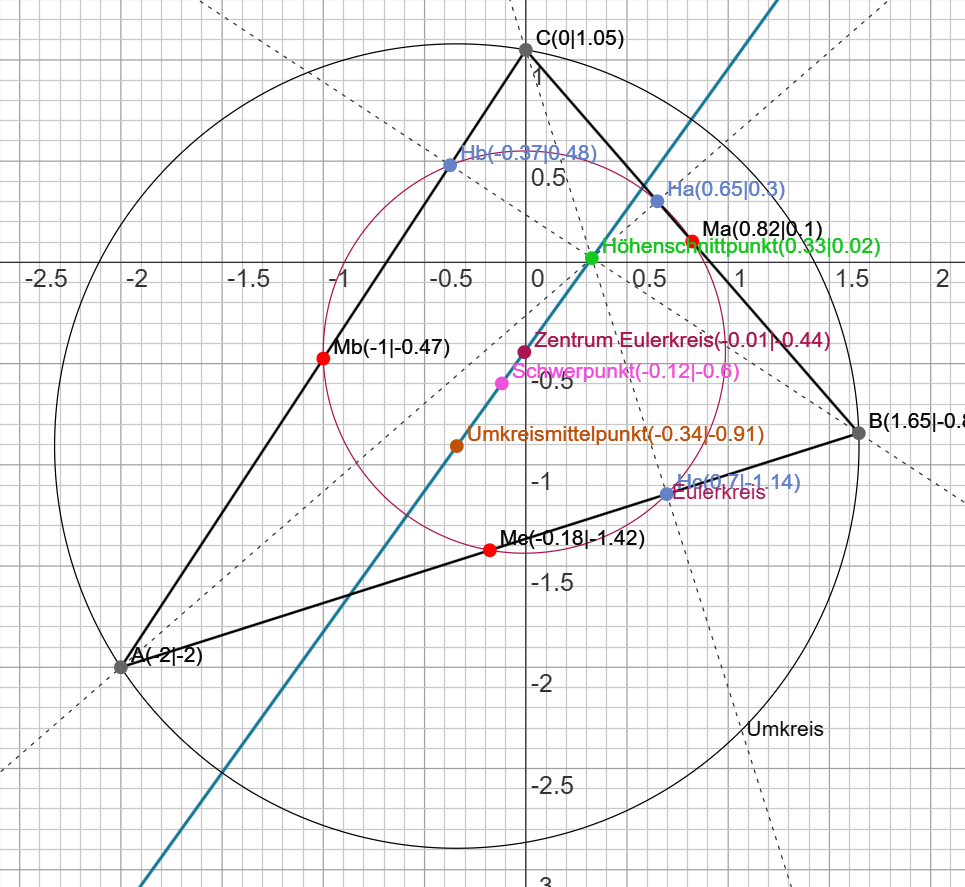
Der Feuerbachkreis (auch Eulerkreis, Neunpunktkreis oder Mittelpunktkreis) ist einer der bemerkenswertesten Kreise in der klassischen Dreiecksgeometrie. Wie sein Name andeutet, verläuft er durch neun ganz besondere Punkte eines beliebigen (nicht rechtwinkligen) Dreiecks $\triangle ABC$.
1 Die neun Punkte
- Seitenmitten $M_a,\,M_b,\,M_c$
- Höhenfüße $H_a,\,H_b,\,H_c$
- Mitten der Orthozentervektoren $D_a,\,D_b,\,D_c$ – jeweils Mittelpunkt zwischen einem Eckpunkt und dem Höhenschnittpunkt $H$.
Alle diese neun Punkte liegen auf demselben Kreis. (Die kleine App "Apollonius" veranschaulicht den Eulerkreis interaktiv. Kicke hier um App zu starten). Das Resultat wurde in dieser Vollständigkeit erstmals von K. W. Feuerbach (1822) veröffentlicht, die grundlegenden Eigenschaften gehen allerdings auf Leonhard Euler (1765) zurück.
2 Lage des Kreismittelpunkts $N$
Bezeichnet $O$ den Umkreismittelpunkt und $H$ den Höhenschnittpunkt des Dreiecks, so gilt
$\displaystyle N = \frac{H + O}{2}$
– der Schwerpunkt der Strecke $OH$. Das Zentrum des Neunpunktkreises liegt also auf der berühmten Euler-Linie, die durch $O$, den Schwerpunkt $S$ und $H$ verläuft.
3 Radius
Sei $R$ der Radius des Umkreises. Dann besitzt der Neunpunktkreis den Radius
$\displaystyle r = \tfrac{R}{2}$.
Der Halbmesser ist also exakt halb so groß wie der des Umkreises.
4 Berührpunkte (Feuerbach-Satz)
Ein weiterer klassischer Satz lautet: Der Neunpunktkreis berührt sowohl den Inkreis als auch alle drei Ankreise des Dreiecks. Dieser schöne Tangential-Zusammenhang wird als Feuerbach-Satz bezeichnet.
5 Analytische Darstellung
Seien die Eckpunkte in kartesischen Koordinaten gegeben:
$A(x_A,y_A),\; B(x_B,y_B),\; C(x_C,y_C)$.
Dann gilt für das Kreismittel $N$
$\displaystyle N= \bigl(\tfrac{x_A+x_B+x_C+x_H}{4},\; \tfrac{y_A+y_B+y_C+y_H}{4}\bigr)$,
wobei $(x_H,y_H)$ die Koordinaten des Orthozentrums sind. Die Gleichung des Kreises lautet entsprechend
$(x - x_N)^2 + (y - y_N)^2 = \bigl(\tfrac{R}{2}\bigr)^2$.
6 Konstruktionsschritte (klassisch)
- Zeichne die drei Höhen und ihren Schnittpunkt $H$.
- Trage die drei Seitenmitten $M_a, M_b, M_c$ ab.
- Verbinde $H$ mit jedem Eckpunkt und markiere dessen Mittelpunkt $D_a, D_b, D_c$.
- Bestimme zwei dieser neun Punkte, schlage den Kreis mit entsprechendem Radius; er geht automatisch durch die übrigen sieben Punkte.